You probably want to know why you should trust me with something as significant as upending your life and moving to another country.
Fair.
I could list credentials. They’re decent—a career in marketing that generated millions in revenue, awards, speaking invitations, all the things that look impressive on paper but don’t actually tell you whether I know what I’m talking about when it comes to navigating the préfecture or finding an apartment that won’t bankrupt you.
So instead, let me tell you about thirty years of cowardice.
I first saw Paris at sixteen. Worked extra jobs all year to afford a two-week trip to Europe—my first time in a big city, my first time outside America. New York and London were impressive. Paris was different.
It wasn’t the monuments. It was the streets where Chopin had walked. The sense that history wasn’t something you read about—it was something you stood in. I made a promise to myself, standing on the Pont Neuf like every other romantic teenager who’s ever visited: I’ll live here someday.
Then I went home and spent the next thirty years not doing anything about it.
Life intervened. A degree. A career. Nine cities in five states, each move its own reinvention. I told myself I was building something. And I was—a marketing executive with a nice salary and a growing suspicion that I’d traded my life for my résumé.
Every few years, the Paris dream would surface. I’d feel the pull. Then I’d file it under “someday” and get back to work.
Here’s what nobody tells you about deferred dreams: they don’t go away. They just get quieter. And that quiet turns into a hum of regret you can ignore for years—until suddenly you can’t.
By 2012, the hum had become deafening.
I was forty-five. Successful by every external measure. And increasingly aware that “someday” was a lie I’d been telling myself for three decades. A friend, tired of hearing me talk about Paris for the thousandth time, finally said what needed to be said:
“Why don’t you just shut up and do it?”
So in 2013, I did.
I quit my job. Sold everything that wouldn’t fit in two suitcases. Bought a one-way ticket to a city where I couldn’t read my own electricity bill.
No apartment lined up. No job waiting. No friends on the ground. French that was optimistic at best—I could order coffee and apologize, and that was about the extent of it.
What I did have: a conviction that if I waited until retirement, I’d arrive in Paris as an old man with a tourist’s relationship to the city. And savings. And a willingness to figure it out or come crawling back to America with my tail between my legs.
I was terrified. But I was also, finally, free.
The first year was a bit brutal. I won’t romanticize it.
Everything that had made me competent in America—my network, my cultural fluency, my ability to navigate systems instinctively—none of it applied. I was functionally illiterate in everyday situations. I showed up to appointments without the right paperwork. I spent entire days accomplishing one task that would have taken ten minutes back home.
There was the afternoon I told a gardienne that her building smelled like cheese when I meant to compliment the courtyard flowers. (The verb sentir—to smell or to feel—is treacherous.) She didn’t speak to me for months.
There was the three hours at the bank when I didn’t understand that “revenez demain” wasn’t a suggestion to come back tomorrow—it was a dismissal. I kept trying to solve the problem. They kept waiting for me to leave. We were having entirely different conversations.
There was the apartment scam I almost fell for, the currency exchange that cost me hundreds, the bureaucratic maze I entered confidently and exited humiliated.
I lay awake at night wondering if I’d made the worst decision of my life.
But here’s what those disasters taught me: the French respect people who try, even badly. The bureaucrat who seemed impossible at 9am becomes almost human at 4:30pm when you come back with the right documents and a humble “je suis vraiment désolé.” The mistakes are how you earn your place here.
And slowly, the terror faded. Something else took its place.
I didn’t come to Paris with a plan. I came with savings and determination and a willingness to say yes to whatever appeared.
What appeared was more than I could have imagined.
I fell into property management—helping one friend rent their apartment, then another, then managing hundreds across the city. I became a certified tour director, creating private experiences for visitors who wanted more than the standard script. I worked as a relocation consultant, helping Americans navigate the maze of French bureaucracy that I’d barely survived myself.
I learned which landlords were trustworthy and which were predatory. Which neighborhoods worked for which lifestyles. Which shortcuts actually functioned and which were traps. I accumulated the kind of knowledge that only comes from doing—from making every possible mistake and eventually figuring out what works.
I never stopped teaching music. Piano students aged five to seventy. A gay men’s choir in the Marais. In 2020, Expatriates Magazine named me Best Music Teacher in Paris—a strange and lovely full-circle for a kid who started on a two-octave Sears keyboard in a mobile home in Indiana.
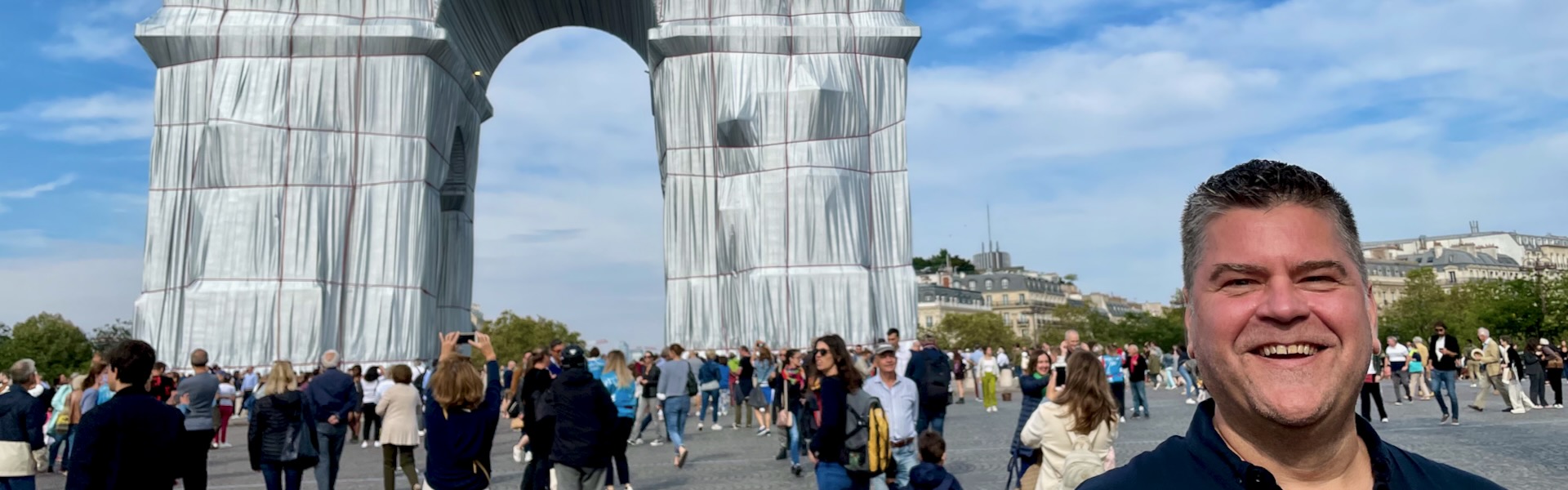
I found love. I live in Montmartre now with my husband Roberto, in an apartment where I can see rooftops and sky and feel, genuinely, that I am home.
None of this was guaranteed when I stepped off that plane in 2013. I built it. Piece by piece, mistake by mistake, year by year.
Everything I learned over thirteen years—the workarounds, the unwritten rules, the actual process of how things work here—I’ve put into ParisDiscovered™.
Because I remember what it felt like to have no idea what I was doing. To feel stupid and lost and completely alone. To wish that someone who’d been through it would just tell me how it actually worked.
I didn’t have a guide when I moved. I didn’t have anyone to call when I was standing in a government office with the wrong photocopy, or when the apartment listing turned out to be a scam, or when I accidentally insulted someone’s building and couldn’t figure out why they were angry.
I want to be the friend in Paris you don’t have yet.
Not a guru. Not an expert dispensing wisdom from above. Just someone who made the leap a dozen years ago and learned, through considerable trial and error, how this place actually works. Someone who’ll tell you what’s hard, what’s easy, and what nobody warns you about.
I’ll be direct with you throughout this course. If something is difficult, I’ll tell you it’s difficult. If there’s a shortcut, I’ll share it. If the French way of doing something makes no sense to American logic, I’ll acknowledge that—but I’ll also help you work within the system rather than fight it.
Fighting the system never works. Trust me.
And I’ll tell you what I discovered after thirty years of waiting and thirteen years of living here: Paris can become home. Not immediately. Not easily. But genuinely.
The view from my window in Montmartre. The café where the owner knows my order. The markets I navigate by instinct. The sense of having finally become the person I was supposed to be.
I built this life. You can build yours.
Now that you know who’s guiding you, let’s look at Paris itself—the city you’re about to call home.